
AI Summary of Hacking Bigfoot
AI summary
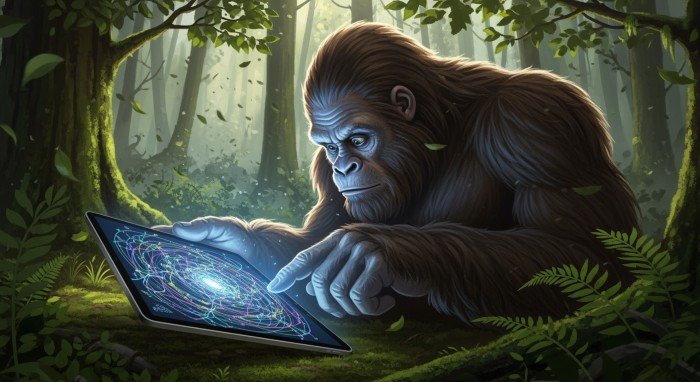
Hacking Bigfoot
Hacking Bigfoot by Marcus Daily explores Bigfoot by navigating a complex landscape of belief, skepticism, folklore, and scientific inquiry. The book aims to provide sustainable theories around international aspects of Bigfoot research, integrating analysis through anthropology, biology, and geography.
Historical Context of Bigfoot
Worldwide indigenous folklore contains strong clues about hairy wild beings, suggesting a long history of such creatures. Various regional names and descriptions exist for similar creatures across the world, indicating a shared cultural phenomenon.
The Complexity of the Bigfoot Phenomenon
The existence of Bigfoot presents a paradox that challenges conventional understanding and belief systems. Bigfoot is both a real phenomenon and an impossible concept.
The science of Bigfoot may not exist but the science of biology and ecology are well-defined for other aspects of earth history in a biomolecular sense. Clues from prehistory are not readily apparent to our familiar senses. Solving the paradox demands overriding the long standing belief that bipedalism is one and the same as the Out of Africa paradigm where a neatly defined progression of bipedalism occurred generationally over many thousands or millions of years.
Hacking Bigfoot proposes Bigfoot is a genuine unknown species which precedes and has always existed outside of human evolution as well as known animal taxonomies. Neanderthal and Denisovan lineages are likewise ruled out. There is no DNA of Homo erectus or earlier pre-Sapiens lineages to verify for certain but all are highly unlikely Bigfoot candidates.
The Limitations of Bigfoot DNA Testing
Aside from the rarity of finding exceptional evidence, DNA testing presents challenges in obtaining reliable results. Hoaxing is responsible but also environmental factors, the speed of degradation of samples and contamination issues also play a role.
There are many misunderstandings with DNA testing such as it being an identifier of a new species. DNA testing only specifies how close a sample is to something else that is already known.
Proposed Bigfoot hairs are useless for genomic testing.
eDNA testing is only effective for known species. eDNA does not provide useful information for unidentified species like Bigfoot.
The main reason why Bigfoot DNA won’t pan out is the absence of a reference genome. Identifying potential DNA matches of Bigfoot is impossible without multiple DNA samples to compare to.
Theories and Controversies in Bigfootery
Various eyewitness accounts and folklore highlight the emotional impact of encounters and a subsequent lifelong pursuit for answers.
The phenomenon has led to a community of enthusiasts and researchers dedicated to uncovering the truth about Bigfoot. Each generation of seekers faces cycles of hope, frustration, denial, and disappointment in their quest for answers. Instead of evolving perspectives, Bigfootery is an endless cycle of repetitive narratives and sensationalism.
The idea of Bigfoot being real irritates some people because it challenges their understanding of the natural world and forces them to confront deeply embedded fears about humanity’s unknown evolutionary past.
Bigfoot is a Mental and Physical Challenge
Biomolecular realities bother some scientists, Bigfooters, as well as creationists because genomics adds a layer of certainty that is impossible to contradict. Previously it was much easier to object to theories based on lifeless fossils and artifacts. While we have no knowledge of Bigfoot’s evolutionary history, genomic studies of humans, chimps and other great apes, gives us many reasons why Bigfoot is not part of primate evolution.
Science is a process of elimination. It tosses out implausibility until all that is left are crumbs of unknowns. Those flecks of details are clues that Hacking Bigfoot uses to create a profile of a species that prefers very strongly to remain unknown.
The Paradox of Bigfoot Truth
Hacking Bigfoot suggests that Bigfoot may represent a lineage of bipedal species that coexisted completely separate from early humans. Thousands of creatures have evolved and gone extinct and some of them left distinct patterns of how they developed in isolation.
Bigfoot may be one of many other pre-Sapiens that could have originated outside of Africa. It is interesting to note that while old school paleo scientists are resistant to letting their ideas go, It’s no longer outlandish for other paleo scientists to suggest theories that run contrary to Out of Africa using biomolecular data.
Much like Bigfoot researchers are stubborn about their views, the world of science and academia are twice as bullish when it comes to proving through physical evidence.
See also the placement.pub linktr.ee.
#BigfootIsReal #BigfootIsNotBeautiful