
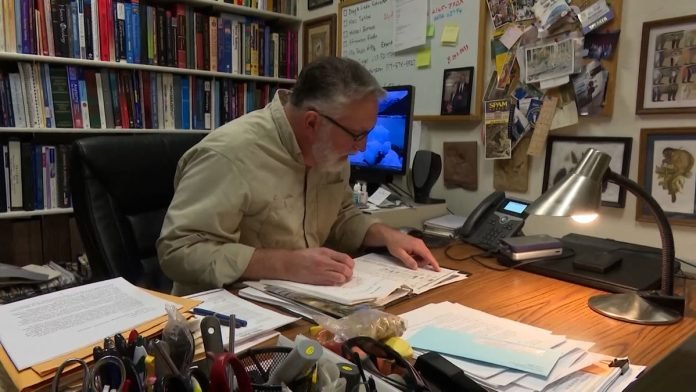
Since Dr. Jeff Meldrum’s passing a few weeks ago, I have been thinking about what I can add to the eulogy. I never met him personally but it felt like I knew him because of the hundreds of interviews he has done over the years. He was the primary – and some may say, the only member of the academic community – to publicly take a stand on the existence of Bigfoot as a valid area of anthropological study.
As such, he was a focus of attention and was the go-to resource when mainstream media needed a credible voice to weigh in on the many hoaxes that have repeatedly plagued Bigfootery.
Even when interviewers or random members of the public would critique his areas of expertise, he had a response ready at hand:
“This is legitimate research. This could be one of the most outstanding questions in natural history and human anthropology that we have today. I’ve gone to great lengths to go about it in a very objective, very professional manner in order to cultivate credibility.”1 — Dr. Jeff Meldrum, professor of anatomy and physical anthropology
Dr. Meldrum also faced criticism from some of his academic peers at Idaho State University as well as from other colleges.
Even among his supporters, there was a sentiment that Meldrum was a tool of the broadcasting entertainment business. He acknowledged that his field work was unique from other academicians in that regard.
Criticism didn’t slow him down. Dr. Meldrum was the face of Bigfootery for a long time and he left no successor.
For anyone considering it, it’s rare to make a decent living from Bigfoot, especially in academics.
Relict Hominoids
Meldrum’s magnum opus was a book on Bigfoot footprints: Legend Meets Science published in 2006. Tens of thousands of copies have been sold since that time.
“Idaho State University has in some ways been kind of put on the map as the only university that has a resident faculty member who is publishing on this subject. And that’s noteworthy.”2 — Dr. Jeff Meldrum, professor of anatomy and physical anthropology
Dr. Meldrum acquired the Relict Hominoid Inquiry, the only peer reviewed academic journal covering Bigfoot. The term relict hominoid and the journal was the creation of Boris Porshnev, the Soviet Union’s most esteemed Snowman investigator of the 1950’s and 60s.
To study the Snowman phenomena from an eastern academic perspective, Porshnev and his colleagues developed an anthropological framework known as Hominology. Even though Porshnev and his team took the Snowman very seriously, the journal was a Soviet propaganda tool, intended to irritate the West’s Darwinist scientific values.
Boris Porshnev strongly believed that Bigfoot was a Neanderthal, hence a “relict.” Despite an outdated Soviet mission statement, the journal had value to Meldrum because it was already accredited and set up for peer review.
Dr. Meldrum did not continue Porshnev’s interpretations. He created his own version of relict hominoid and welcomed contributions to the journal from inside and outside of academia. Though, contributions had to have strong scientific context to be considered worthy of publishing.
The term relict hominoid never gained traction outside of Bigfootery and has been entirely ignored by the field of anthropology.
Jeff Meldrum’s Legacy
“Even if definitive DNA data points to the existence of a novel species, it will not suddenly become easy to study such a rare and elusive primate in the field.”3 — Dr. Jeff Meldrum, professor of anatomy and physical anthropology
Jeff Meldrum is irreplaceable and was a huge part of the history of Bigfootery. Beyond his contributions, the bigger picture of Bigfoot research is it continues to be scientifically roadblocked. There just isn’t much in the way of credible findings that can be sufficiently studied. Physical anthropology requires artifacts, which is why, in my view, Meldrum stuck to footprints as the backbone of his research focus.
Bigfoot footprints can only go so far. Bigfoot research needs a lot more real-time field data and interpretation of that data to make any significant headway in understanding the phenomena. It will be up to the next generation of Bigfooters to build off of the pioneering work of Jeff Meldrum make that happen.
- “Idaho State professor publishes research on Sasquatch.” AP News on Oregonlive.com, September 05, 2012. ↩︎
- “This Drone Is Going To Find Bigfoot” by Stan Alcorn, Fast Company, Oct 1, 2013. ↩︎
- “Bigfoot research gets lift from stealth airship.” NBCNews.com, October 15, 2012. ↩︎
My book, Hacking Bigfoot, covers some of Dr. Meldrum’s notable career highlights like Snelgrove Lake, Siberia, and his trip to Nordegg with Todd Standing.